At Zenith Cleaning Service, we provide cleaning services for cafés, restaurants, pubs, and catering kitchens across Adelaide. In this guide, we answer one of the most common questions in hospitality cleaning: how often should a commercial kitchen be deep cleaned?
We also share a simple cleaning schedule, explain what a deep clean should cover, outline what South Australian food safety rules say and list the signs that your kitchen needs attention sooner.
The short answer: Most busy commercial kitchens need a deep clean of key areas once a week. Some areas can be deep cleaned once a month, and exhaust systems should be cleaned based on regular inspections. Daily cleaning and sanitising must still happen every day.
Australian law does not set one deep-cleaning timetable for every kitchen. Instead, it says your kitchen must stay clean, and grease, dirt and food waste must not be allowed to build up.
How Often Should You Deep Clean a Commercial Kitchen?
The right schedule depends on how your kitchen works. A takeaway shop running fryers all day builds up grease much faster than a café that mostly makes sandwiches and salads. A kitchen serving hundreds of meals a day also needs deep cleaning more often than a small kitchen with short trading hours.
That is why we suggest planning by area instead of treating the whole kitchen as one job. Each surface and piece of equipment gets its own cleaning frequency, based on how fast it gets dirty and how much risk it carries.
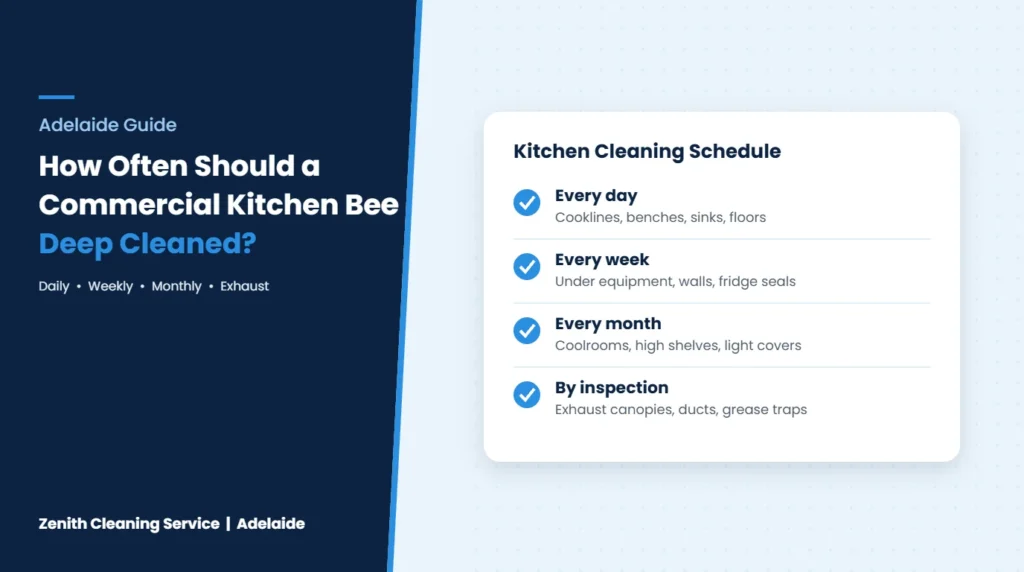
Commercial Kitchen Cleaning Frequency Chart
| How Often | What to Clean |
|---|---|
| After each use, or whenever it gets dirty | Chopping boards, knives, utensils and food-contact benches (clean first, then sanitise) |
| Every day | Cooktops, grills, the outside of fryers, benches, sinks, floors, bins, door handles and light switches |
| Every week (busy kitchens) | Behind and under movable equipment, floor edges and corners, walls and splashbacks near the cookline, fridge shelves and door seals, open shelving |
| Every month, or sooner if needed | Coolroom walls and floors, high shelves, light covers, dry storage areas and equipment you use less often |
| Based on inspection | Exhaust canopies, ducts and fans, and grease traps (handled by licensed specialists) |
Use this chart as a starting point, not a legal timetable. If an area gets dirty faster, clean it sooner.
Daily Cleaning Comes First
Daily cleaning is the base of every good kitchen cleaning plan. It removes the food scraps, spills, dirt and grease that build up during a normal day of service. Benches, cooking areas, sinks and floors should be cleaned during service and again at close.
But daily cleaning cannot reach everything. A quick wipe-down at the end of a long shift will not reach the gap behind the fryer or the floor under the coolroom shelving. Those areas are what deep cleaning is for.
If your team finds it hard to keep up with routine cleaning on top of service, our janitorial services can handle regular commercial cleaning on a set schedule.
Weekly Deep Cleaning for Busy Kitchens
For most busy kitchens, a weekly deep clean of key areas is a good starting point. This is when you safely move what can be moved and clean the areas that daily cleaning misses. These include the spaces under and behind equipment, floor edges, walls and splashbacks near the cookline, and fridge shelves and seals.
Weekly is not a fixed rule, though. If grease builds up on your cookline within three days, that area needs cleaning every three days.
Monthly Deep Cleaning for Less-Used Areas
Some areas get dirty more slowly. High shelves, light covers, coolroom walls and dry storage areas can often be deep cleaned once a month. Check them during your weekly clean, and if you see dirt, spills or mould, deal with it straight away. Never leave visible dirt just because the next scheduled clean is weeks away.
What Is the Difference Between Daily Cleaning and Deep Cleaning?
Daily cleaning keeps the kitchen safe and tidy during normal trading. Deep cleaning goes further. It takes more time, often needs equipment moved and reaches places that daily cleaning cannot.
For example, your kitchen team may mop the open floor every night. During a deep clean, the grease and food scraps that collect under equipment and along the edges, where the mop does not reach, are cleaned as well.
It helps to think of kitchen cleaning as four separate jobs:
- Routine cleaning: Removing spills, food waste, dirt and grease during everyday work.
- Deep cleaning: Thoroughly cleaning the areas where dirt and grease build up despite daily cleaning.
- Sanitising: Killing germs on food-contact surfaces and utensils.
- Specialist maintenance: Inspecting and cleaning systems such as exhaust ducts and grease traps.
What Should Be Included in a Commercial Kitchen Deep Clean?
Every kitchen is different, so the deep-clean scope should match your layout, your equipment and the food you handle. Before we start any job, we agree on a written scope, so everyone knows exactly which areas are included.
1. Cooking Equipment and Surrounding Surfaces
Cooktops, ovens, grills and fryers produce a lot of grease. A deep clean should cover the outside of this equipment, the splashbacks and walls behind it, and any other surface where grease settles.
Cookline degreasing of cooktops, ovens and fryers is part of our hospitality cleaning scope. For safety, equipment must be switched off and allowed to cool before cleaning. Cleaning products should suit the surface and be used as the manufacturer advises. Repairs, gas or electrical work and taking equipment apart should only be done by qualified technicians.
2. Floors, Corners and Under Equipment
Kitchen floors take spilled food, oil, water and constant foot traffic. Daily mopping often misses corners, edges and the space under benches and appliances. A deep clean should cover:
- Floor edges and corners
- Spaces under and behind movable appliances
- Areas around cooking stations
- Greasy or sticky patches
- The area around floor drains
A clean floor is also a safety issue. A slip near the fryer or the pass can quickly turn into a burn or scald when staff are carrying hot oil, boiling water or full trays. That is why we give floors near the cookline extra attention and proper drying time, and we keep wet-floor signs in place until the floor is dry.
3. Food Preparation Surfaces
Prep benches, chopping boards and utensils need extra care, because germs on these surfaces can pass straight into food. The FSANZ method is simple:
- Pre-clean – Scrape or wipe off food scraps and rinse with water.
- Wash – Use hot water and detergent to remove grease and food residue. Soak items if needed.
- Rinse – Rinse off the detergent.
- Sanitise – Use very hot water (77°C for 30 seconds), a diluted bleach solution, a commercial sanitiser used as the label directs, or a dishwasher that can sanitise.
- Dry – Let items air-dry where possible.
Food-contact surfaces need this every time they are used or become dirty, not only on deep-clean day.
In food preparation areas, our cleaners use colour-coded cloths, mops and equipment. This helps prevent germs from spreading between kitchens, bathrooms and other areas of your venue.
4. Fridges, Coolrooms and Storage Areas
Shelves, handles, door seals and the inside walls of fridges and coolrooms can collect spills and food residue. Dry storage shelves also gather dust and crumbs that can attract pests.
When cleaning these areas, protect the food first. Move stock to safe cold storage, keep the cleaning time short and make sure fridges are back at the right temperature before you restock them.
5. Exhaust Canopies, Ducts and Grease Filters
Exhaust systems need a different approach. Cooking sends grease-filled air into the canopy, where grease builds up on the filters, ducts and fans. This creates both a hygiene problem and a fire risk.
The Australian Institute of Refrigeration, Air Conditioning and Heating (AIRAH) best practice guide notes that kitchens are the number one source of building fires in Australia, and that grease inside the exhaust system helps a small fire spread. The guide recommends deciding how often to clean by inspecting the system and measuring the grease. As a guide, it suggests inspections every three months for high-volume cooking, every six months for moderate cooking, once a year for low-volume cooking and monthly for solid-fuel cooking such as wood-fired ovens. Between professional cleans, kitchen teams should clean hood filters and drains daily or weekly, following the manufacturer’s instructions.
Exhaust canopy cleaning and grease trap pump-outs are handled by separately licensed specialist contractors. This work is not part of our service, but we are happy to plan our cleans around theirs.
What Affects How Often Your Kitchen Needs a Deep Clean?
No two kitchens should follow exactly the same schedule. These five factors make the biggest difference.
Cooking Volume and Trading Hours
More meals mean more spills and more grease. Long trading hours also leave less time to clean. A venue that is open from breakfast to late dinner may need its deep cleaning done overnight or before opening.
Type of Cooking
Frying, grilling, roasting and wok cooking create far more grease than cold food prep. Watch grease-prone areas closely, and shorten the gap between cleans if grease comes back quickly.
Kitchen Layout
Narrow gaps, fixed benches and equipment pushed against walls make cleaning harder. These hard-to-reach spots often need extra time during a deep clean.
Type of Food Handled
Kitchens that handle raw meat, seafood and ready-to-eat food need strict cleaning and sanitising to stop germs from spreading. Food-contact surfaces must be cleaned and sanitised based on use, not on a weekly timetable.
Results From Past Cleans
If the same areas are still greasy or dirty after each clean, the schedule is not working. Clean those areas more often, or change the cleaning method.
These same factors also affect what cleaning costs. For a closer look, see our guide to restaurant cleaning cost per square metre in Adelaide.
Is Commercial Kitchen Deep Cleaning a Legal Requirement in Adelaide?
Food businesses in South Australia must follow the Food Act 2001 (SA) and the Australia New Zealand Food Standards Code. These rules focus on keeping your kitchen clean at all times. They do not set one fixed weekly or monthly date for a deep clean.
Standard 3.2.2: Keep the Kitchen Clean
Under Standard 3.2.2, food businesses must keep their premises, fixtures, fittings and equipment clean. Food scraps, rubbish, dirt and grease must not be left to build up, and the surfaces and utensils that touch food must be clean and sanitised.
In plain terms, a deep clean booked for next week does not excuse a greasy bench today.
Standard 3.2.2A: Food Safety Management Tools
Standard 3.2.2A came into effect in December 2023. It applies to food service, catering and retail businesses that handle unpackaged, high-risk, ready-to-eat food that needs temperature control to stay safe. FSANZ calls this “potentially hazardous food”. Restaurants, cafés, takeaway shops, pubs and caterers are generally covered.
- Category one businesses, such as restaurants and caterers that prepare and serve this food, need three tools: a certified Food Safety Supervisor, trained food handlers, and evidence that key food safety controls, including cleaning and sanitising, are being met.
- Category two businesses, such as retailers that sell this food but do not make it on site, need a Food Safety Supervisor and trained food handlers.
Food handler training must cover the cleaning and sanitising of premises and equipment. For category one businesses, records kept as evidence must be held for at least three months. These records can be electronic, and a business may also show a food safety officer in other ways that it is meeting the rules.
Does Professional Cleaning Make Your Kitchen Compliant?
No cleaning company can promise compliance on its own. Your business is still responsible for safe food handling, daily cleaning and sanitising, equipment upkeep and its own food safety records.
What professional cleaning can do is support your program. At Zenith, every clean is reviewed by a dedicated Area Supervisor and recorded in a digital logbook. These records give you written proof of the cleaning we carry out, which supports your Standard 3.2.2A record-keeping. They do not replace the separate records your business must keep.
Signs Your Commercial Kitchen Needs a Deep Clean Sooner
Even a good schedule needs to change when your kitchen shows signs of trouble. Watch for these warning signs:
- Grease comes back fast – Cooking areas feel greasy again soon after routine cleaning.
- Dirt stays in hidden spots – Food residue sits under benches, behind equipment or in corners.
- Bad smells linger – Odours remain after normal cleaning and rubbish removal.
- Floors feel sticky – Grease stays on the floor even after mopping.
- Filters fill up quickly – Canopy filters are heavy with grease sooner than usual.
- The same problems keep showing up – Your internal checks keep finding the same cleaning issues.
- Signs of pests – Droppings or insects near food or storage areas. Call a licensed pest controller and deep clean the affected area.
When you see these signs, check the affected area straight away instead of waiting for the next scheduled clean. Some problems only need extra cleaning. Others may point to an equipment fault or a job for a specialist.
How to Create a Commercial Kitchen Deep Cleaning Schedule
A good schedule is one your staff can follow every day and your managers can check easily. Here is a simple way to build one:
- List every area and piece of equipment that needs cleaning.
- Decide how each item should be cleaned and how often.
- Name the person or team responsible.
- Record when each task is done.
- Review the schedule regularly and adjust it.
| Kitchen Area | Cleaning Approach | Who Is Responsible |
|---|---|---|
| Food prep benches | Clean and sanitise during and after use | Kitchen staff |
| Cookline surfaces | Daily cleaning plus regular degreasing | Kitchen staff or professional cleaners |
| Floor edges and spaces under equipment | Scheduled deep cleaning | Professional cleaners or assigned staff |
| Fridges, coolrooms and storage | Routine cleaning plus a planned thorough clean | Designated staff |
| Exhaust ducts, fans and grease traps | Inspection and cleaning | Licensed specialist contractors |
Keep Responsibilities Clear
Every staff member should know which tasks are theirs and when they must be done. When we set up a cleaning arrangement, the agreed scope makes clear which areas we cover and which stay with your kitchen team. You can see how this works in practice in our Adelaide cleaning case studies.
Review the Schedule Regularly
Review your schedule when your trading hours change, when you add new equipment or when inspections show the kitchen is not staying clean enough. As your business grows, your cleaning plan should grow with it.
When Should You Hire Professional Commercial Kitchen Cleaners?
Daily cleaning is part of running a kitchen. But deep cleaning takes time and labour that a busy hospitality team often cannot spare after a long service. Professional help is worth considering when:
- Grease and dirt keep building up in areas your team cannot reach during normal cleaning.
- Cleaning needs to happen outside trading hours.
- Floors, equipment and walls need a more thorough clean than daily cleaning provides.
- You want a regular cleaning arrangement with a clear scope.
- You need cleaning tasks recorded and checked.
At Zenith, every cleaner is a directly employed, trained team member, not a subcontractor. You also get a dedicated Area Supervisor who knows your venue, your layout and your service hours.
Commercial Kitchen Cleaning in Adelaide With Zenith Cleaning Service
We provide commercial kitchen cleaning in Adelaide for restaurants, cafés, pubs, catering kitchens and function venues. Our hospitality cleaning covers food preparation areas, kitchen equipment exteriors, grease-prone surfaces, storage areas and kitchen floors, along with degreasing of cooktops, ovens and fryers. We offer daily, weekly or one-off deep cleans.
Here is how we work:
- Site assessment first: We visit your venue, walk through the space with you and note your layout, service hours and cleaning needs.
- Written scope and fixed price: You receive a written cleaning scope and a fixed-price quote before any work begins.
- Cleaning around your trade: We clean before opening, after close or overnight, so your service is not disrupted.
- Proof of every clean: Every clean comes with colour-coded equipment, supervisor sign-off and a digital logbook record. ATP surface testing, a quick test that shows how clean a surface really is beyond what the eye can see, can also be included.
Every clean is backed by ISO 9001 processes, $20 million public liability insurance, ReturnToWorkSA registration and a current national police clearance for every cleaner. There is no long lock-in contract either. A 30-day cancellation policy applies to every agreement.
What Our Adelaide Restaurant Customers Say
We are proud to hold a 5.0-star rating on Google. Here is what one restaurant customer in Norwood said after a restaurant floor clean:
We recently used Zenith Cleaning Service for our restaurant floor cleaning in Norwood and were very happy with the result. The team arrived on time, communicated clearly and paid close attention to the bathrooms, kitchen and floors. Everything looked fresh and tidy when they finished. Professional, reliable service and easy to deal with.
From Ram Bahadur Tmg’s Google review
Book a Free Kitchen Cleaning Assessment
Whether you run a restaurant, café, pub or catering kitchen, we can build a cleaning plan around your venue and trading hours. Request a free quote or call us on 0450 763 725 to book your free site assessment.
Frequently Asked Questions
1. How often should a busy restaurant kitchen be deep cleaned?
Most busy restaurant kitchens need a weekly deep clean of key areas, along with daily cleaning and sanitising after use. The right frequency depends on how much you cook, how quickly grease builds up and what your regular checks show.
2. Is weekly deep cleaning mandatory in Australia?
No, Australian food safety standards do not set one weekly deep-cleaning rule for every kitchen. They require you to keep your premises and equipment clean and to stop grease, dirt and food waste from building up.
3. Should commercial kitchen floors be cleaned every day?
Yes, floors in a working commercial kitchen should be cleaned at least once a day, and spills should be cleaned up straight away. Greasy corners and the spaces under equipment also need regular deep cleaning.
4. Is a monthly deep clean enough for a commercial kitchen?
For some low-use areas, such as high shelves or dry storage, a monthly deep clean can be enough. For cooklines, floors and food-contact surfaces in a busy kitchen, monthly cleaning on its own is usually not enough.
5. How often should commercial kitchen exhaust systems be cleaned?
It depends on the type and amount of cooking. As a guide, AIRAH suggests inspections about every three months for high-volume kitchens, every six months for moderate cooking and once a year for low-volume cooking, with cleaning based on how much grease is found. This work should be done by licensed specialists.
6. Do Adelaide restaurants need to keep cleaning records?
Category one businesses under Standard 3.2.2A, which include many restaurants and caterers, must be able to show that cleaning and sanitising requirements are being met. Records kept for this purpose must be held for at least three months. Even where records are not required, a written cleaning schedule makes it easier to manage your team.
7. Can professional cleaners replace daily kitchen cleaning?
No, professional cleaning supports your team, but your business is still responsible for everyday cleaning, sanitising and food safety.
8. Does Zenith Cleaning Service offer after-hours restaurant cleaning in Adelaide?
Yes, we clean before opening, after close or overnight, depending on your venue. We confirm the exact scope and schedule during your free site assessment.
Keep Your Commercial Kitchen Cleaning Schedule Practical
A clean commercial kitchen depends on three things working together: daily cleaning and sanitising, scheduled deep cleaning for the areas that daily cleaning misses, and specialist care for systems such as exhaust ducts and grease traps. The best schedule is one that matches your kitchen’s workload, equipment and condition, and changes when those things change.
If you are reviewing your kitchen’s cleaning needs, contact our team for a free, no-obligation quote.